
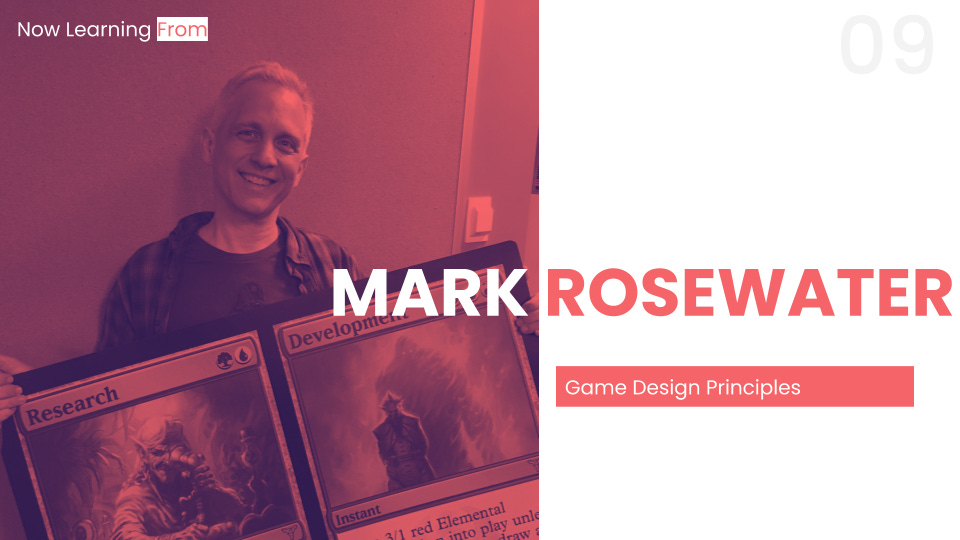
09 Game Design Principles
Now Learning From Mark Rosewater

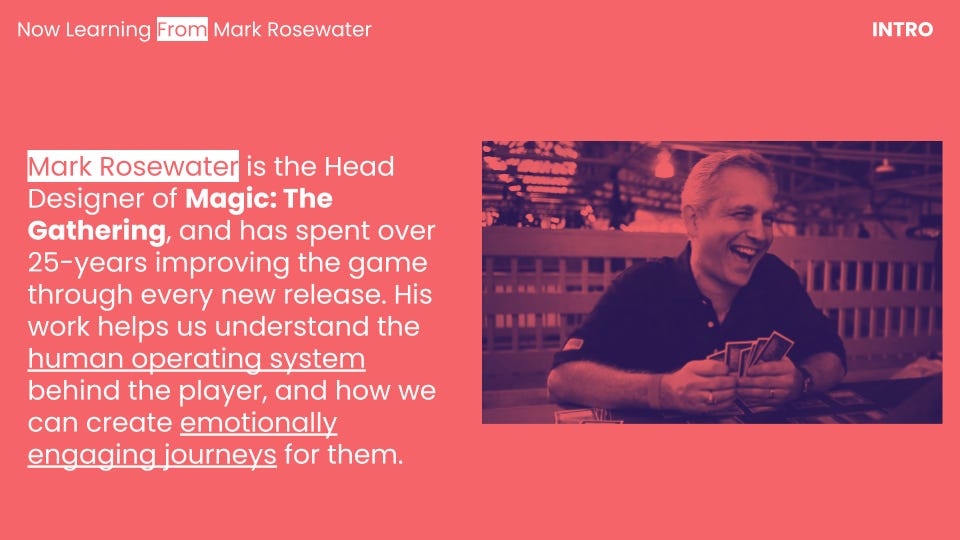
Mark Rosewater is the Head Designer of Magic: The Gathering, and has spent over 25-years improving the game through every new release. His work helps us understand the human operating system behind the player, and how we can create emotionally engaging journeys for them.
Players will do whatever the game incentivizes them to do whether or not that thing is fun. The goal of a game designer is to make the incentives move the players towards the parts of the game that are fun.
-Mark Rosewater
PLAYER BEHAVIOUR
Fighting against human nature is a losing battle. If players are unwilling or unsure how to adopt new features and mechanics - don’t change your players to match your game, change your game to match your players.
PLAYER PERCEPTION
Human beings like to perceive things in a certain way that “feels” right to them. Aesthetics such as balance, symmetry, and pattern completion need to be taken into consideration when designing game components. Disconnecting from these aesthetic expectations distracts players from the game, and makes them feel uneasy. Unless this is intentional. you probably want to avoid this.
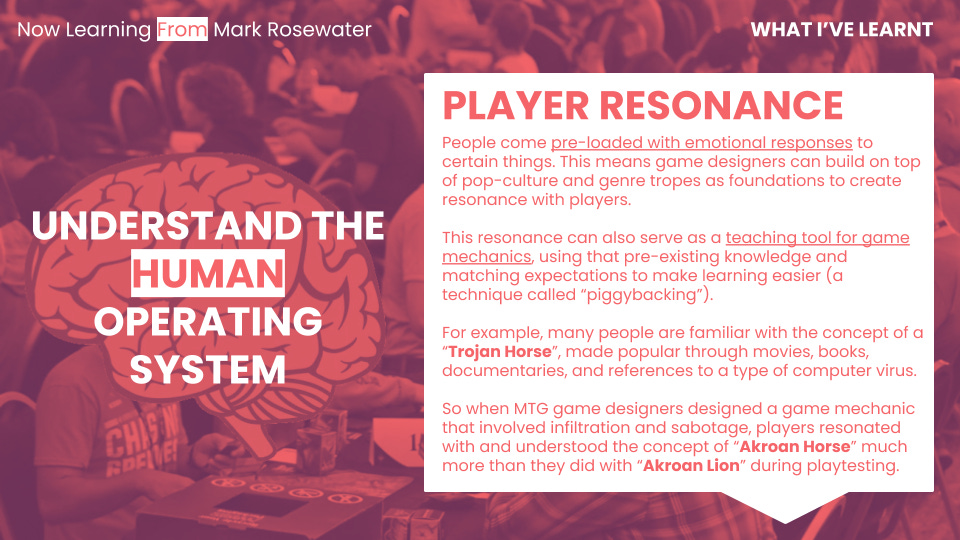
PLAYER RESONANCE
People come pre-loaded with emotional responses to certain things. This means game designers can build on top of pop-culture and genre tropes as foundations to create resonance with players.
This resonance can also serve as a teaching tool for game mechanics, using that pre-existing knowledge and matching expectations to make learning easier (a technique called “piggybacking”).
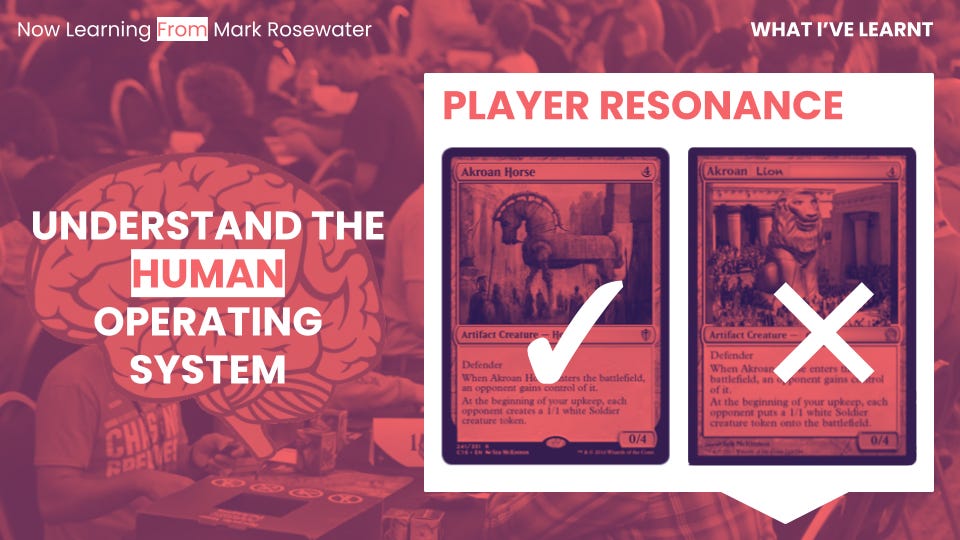
For example, many people are familiar with the concept of a “Trojan Horse”, made popular through movies, books, documentaries, and references to a type of computer virus.
So when MTG game designers designed a game mechanic that involved infiltration and sabotage, players resonated with and understood the concept of “Akroan Horse” much more than they did with “Akroan Lion” during playtesting.
EMOTIONAL RESPONSE
Before designing your game, you need to understand what emotion your game is trying to invoke, and what impact each game choice will have on the game experience.
There is a quote from screenwriting: “No scene is worth a movie, no line is worth a scene”. Everything in the game has to serve a larger purpose (the emotional output). If it doesn’t contribute, cut it.
When creating this emotionally engaging journey, it’s important not to confuse interesting with fun. ‘Interesting’ is an intellectual stimulation, while ‘fun’ is an emotional one.
Players may think of themselves as intellectual, but are more likely to make decisions based on their emotions. These emotional responses are more likely to generate satisfaction, so speak to players on that level.
PLAYER ENGAGEMENT (1)
Allow the player the ability to make the game personal. Players are more engaged with games they have a personal connection to, built through making choices that impact the game. Therefore, provide players with different choices, different paths, different expressions. Allow them to choose (or not choose) at multiple junctures, and feel that the choice is theirs.
The details are where players fall in love with the game. Players often search for something to bond with within the game. It could be an easter egg, inside joke, or obscure reference, which only matters / makes sense to a small percentage of people - but it might mean everything to them.
PLAYER ENGAGEMENT (2)
Allow players to have a sense of ownership. Through customization, find ways of enabling players to create something that is uniquely their own, and able to become an extension of themselves. So when the thing they create wins - they win. Let the game becomes theirs - not yours.
Leave room for the player to explore. People are more invested in the things they initiate. You don’t always need to show the player the things they want to see, let the player find them. Get them to ask questions, and let discovery lead them to emotional investment.
DESIGN FOR THE INTENDED AUDIENCE
When it comes to players, there are 3 general categories:
Players who want to experience something
Players who want to express something
Players who want to prove something
Understand the different kinds of things each player category wants, and maximise the design of each component with the specific target in mind.
If everyone likes your game, but nobody loves it...the game will fail. Try to evoke strong responses (joy, excitement, passion), even if some of the responses might be negative. Players don’t need to love everything about your game, but they do need to love something about it.
FOCUS ON THE FUN
Make the fun part of your game also the right strategy to win. Don’t make players choose between fun and winning.
It’s not the player’s job to find the fun, it’s the designer’s job to put the fun where the player can’t help but find it. When players play a game, there is an implied promise that if they follow through with the game, they will have a good experience.
Thus, fun cannot be tangential, it has to be a core component of the entire experience.
To achieve this, sometimes subtlety doesn’t work and players can miss the obvious. In this case, don’t be afraid to be blunt - even if it means forcing the player down the ‘fun’ path, for their own good.
RESPECT THE PLAYER
Be more afraid of boring your player than challenging them.
Trying something grandiose but failing is memorable. Players can recognize that it could have been awesome, and they’ll forgive you, and see what you’ll try next. They respect the intent.
But when you bore the player, there is no such forgiveness. They’ll resent you and stop playing eventually.
To this end, you should know how to use your players as a resource, a barometer for discovering if problems exist. Players are generally good at recognizing problems, even if they are not as good at solving them.
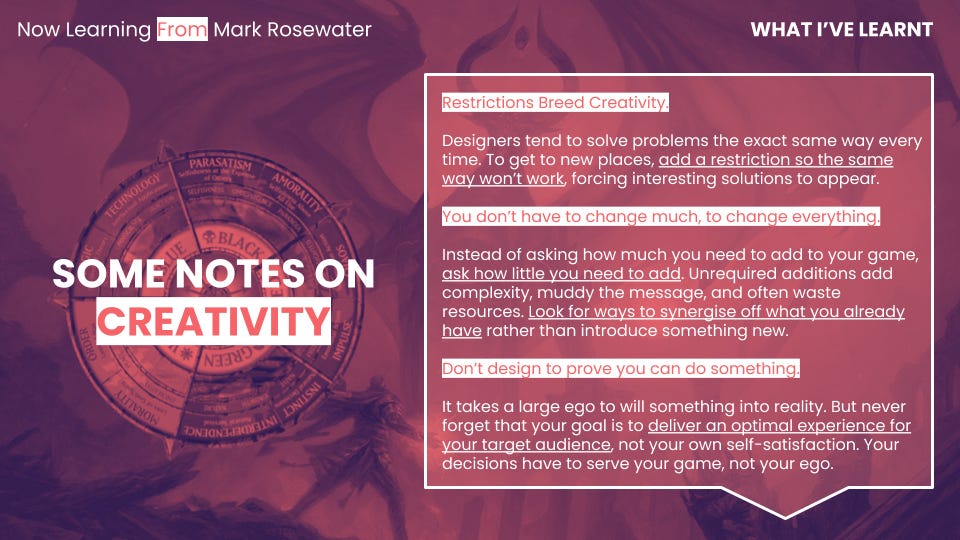
Restrictions Breed Creativity. Designers tend to solve problems the exact same way every time. To get to new places, add a restriction so the same way won’t work, forcing interesting solutions to appear.
You don’t have to change much, to change everything. Instead of asking how much you need to add to your game, ask how little you need to add. Unrequired additions add complexity, muddy the message, and often waste resources. Look for ways to synergise off what you already have rather than introduce something new.
Don’t design to prove you can do something. It takes a large ego to will something into reality. But never forget that your goal is to deliver an optimal experience for your target audience, not your own self-satisfaction. Your decisions have to serve your game, not your ego.
By learning principles and best practices from game design, we are better able to create memorable and engaging experiences for our audiences.
-Mark